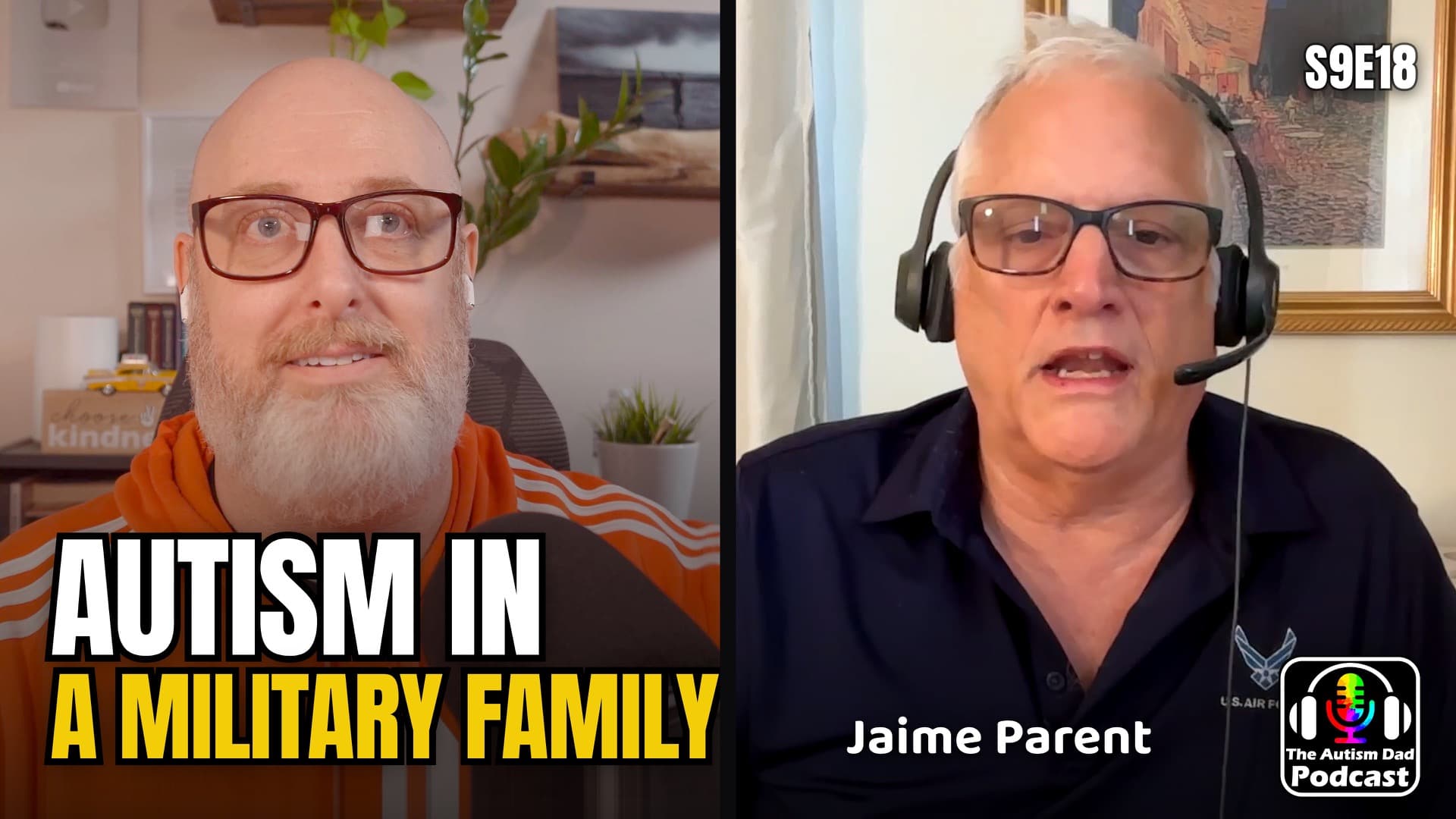
Melvin Lopez is autistic. So is his five year old son, Mateo. And the first thing Melvin does in this conversation is take apart the assumption that those two facts give them something in common.
"A lot of people, they might think, well, it's like you have something in common with your son. Well, that's not necessarily true, because in this house we have a saying that says, if you know one person with autism, you know one person with autism."
They are both Level 2. Both carry the designation that reads "requires substantial support." Melvin was diagnosed as an adult, he has a background in the military, he works, and he is raising four children in Clarksville, Tennessee. Hold those two things next to each other, because most of this episode is about what happens when people can't.
Both Level 2, and still not the same
Same label, same support level, different lives. Melvin is careful about this in a way I do not hear often.
"He has his plight and his needs and his support that he needs, and I have my support, my needs, and everything I need, and those don't necessarily have to interject with each other."
Mateo is five, in kindergarten, and in ABA therapy. The IEP has not started yet because the school says he is too young. Melvin understands the reasoning and still knows his son has needs that are going unaddressed in the meantime.
The day starts at 4:30, ready or not
Melvin has a military background and says he has never wanted to run a tighter schedule than he does now. He also says that want mostly does not happen.
The house wakes at 4:30 in the morning because Mateo does not sleep. Melvin makes the distinction himself. His son rests. He does not sleep. And when he is up, he is not slowly waking up.
"I'm talking about up and fully charged, ready to go."
That energy does not necessarily point toward getting dressed for school. Some mornings start with a meltdown before anything else has happened, and he knows exactly what that does to the rest of the day. So he builds the controls. Routine written down, clothes laid out, a plan.
"And all that goes away when real life happens."
The tools you don't want to need
Here is the part I had not heard put this plainly before. When the plan falls apart, Melvin is not only managing a five year old who will not get dressed. He is managing his own autistic response to a broken plan, at the same time, in the same room.
"I'm fighting my autism as a parent to a child who doesn't want to get dressed. And then I'm fighting my own inside."
He has tools for that, built over years of therapy. And then he said the thing from this episode that I keep repeating to people.
"Nobody's ever gonna tell you that they have some really good tools in their garage, but they don't want to use them every day. You don't want to use it, because that means something's broken every day. You might buy a really nice tool for your garage to use in your car, but you don't want to use it all the time, because that means your car is always broken."
That is the most honest description of coping skills I have heard. Having them is good. Needing them daily is its own weight, and almost nobody talks about that part.
A five year old you cannot threaten
Ask Melvin about Mateo's strengths and he starts with learning. His son lives for it, remembers everything, including what you promised him on a specific day two years ago, and he will hold you to it.
The flip side is a child with no leverage points.
"You cannot threaten him with anything. He knows he stands on that rock. So sometimes it's like dealing with a little adult who knows that there is nothing you can threaten me with."
And then the part that makes it hard rather than just funny.
"And sometimes that's frustrating, because he's right. I can't hit him. He's right. I cannot lose my temper with him. And he's right."
The once a year friends
Every family like this has a version of this conversation. Most of us have never named it as cleanly as he did.
"In our house, sometimes we have to disconnect from the outside world, because we have enough trouble keeping the inside world in order."
People notice. People assume. He wants to be clear that the birthday party they missed was never about the party.
"We call them the once a year friends. And that doesn't mean you care for them less. It doesn't mean that they've been downgraded from friends to acquaintances. It's just, a big part of friendship is understanding what the other people are going through."
The win that doesn't look like a win
I asked for a recent victory. He picked one that would sound like nothing to anyone outside this life.
Mateo used to leave a building and run. Straight for the car, no stopping. Melvin described it as opening a gate on a thoroughbred.
Now he stays on the sidewalk.
If you have ever had a child bolt in a parking lot, you already know why he counted it. I have. It is a safety thing before it is a behavior thing, and every inch of progress buys back a little of the fear you carry at work all day wondering whether someone left a door open at school.
Tolerated, not understood
Then I asked the question this series is named after. Do you feel seen and heard by the outside world?
"I feel like I'm tolerated."
He let that sit, and then explained it.
"To me, there's a difference between being tolerated and being understood."
He is not saying nobody tries. He said the world has made strides. What he is describing is narrower and more uncomfortable than being ignored. It is being handed the microphone and then watching nothing happen.
"Okay, we'll give you a forum, we'll let you say it. But that doesn't mean we're going to take action towards it."
"Our world is getting better about letting people speak, but sometimes I think we struggle with turning our legitimate concerns into actions."
He was just as hard on our own community
The part I did not expect was where he pointed next. He thinks the misunderstanding runs inside the autism community too. Parents get a diagnosis and never look up what the doctor actually told them. Autistic adults dismiss each other based on who looks like they are managing.
"They see someone, quote unquote, as, quote unquote, higher functioning, quote unquote. I hate that term, but just for the sake of context. And they think, oh well, their struggle is not like mine, because they can hold a job. Well yeah, I can hold a job. That doesn't mean I don't struggle."
Remember that he is Level 2 himself. He is not defending someone else there.
He had a fix for it, and it applies to all of us.
"I don't do the more needs or less needs. I do the different needs."
That is the whole episode in a sentence. Not a hierarchy. A difference.
If you take one thing
Read more than your own echo chamber. That was his ask, and he meant it for people inside this community as much as outside it. Find out what a Level 1 kid actually needs. Find out what an autistic adult actually looks like. Find out what the professionals have published rather than what the comment section repeated back to you.
And if someone tells you their family disappeared for a while, believe that it was never about you.
Thanks to this episode's sponsor
Thanks to Lovebug Probiotics for supporting this episode. Probiotics by age, from babies through adults, focused on digestive and immune support. Go to lovebug.com and use code THEAUTISMDAD20 for 20% off.
These statements have not been evaluated by the FDA. These products are not intended to diagnose, treat, cure, or prevent any disease.
Resources mentioned
Melvin has no public social accounts and asked for nothing beyond the chance to say this out loud. If this episode reached you, the comments are the only way anything gets back to him.
More Seen and Heard episodes: listen.theautismdad.com
Preorder Rob's book: theautismdad.com/book
If your child has just been diagnosed with autism, my book is your compassionate first step guide from someone who has lived it. So Your Child Was Just Diagnosed with Autism: Real Talk, Support, and Next Steps from a Dad Who's Been There comes out December 29, 2026 from Fair Winds Press.
If you found this episode helpful, please follow The Autism Dad Podcast on Apple Podcasts, Spotify, or wherever you listen. Visit listen.theautismdad.com for past episodes, resources, and ways to support the show.
You can find Rob at theautismdad.com, on Facebook, Instagram, and TikTok at The Autism Dad, and on YouTube at The Autism Dad. New episodes drop every week at listen.theautismdad.com.