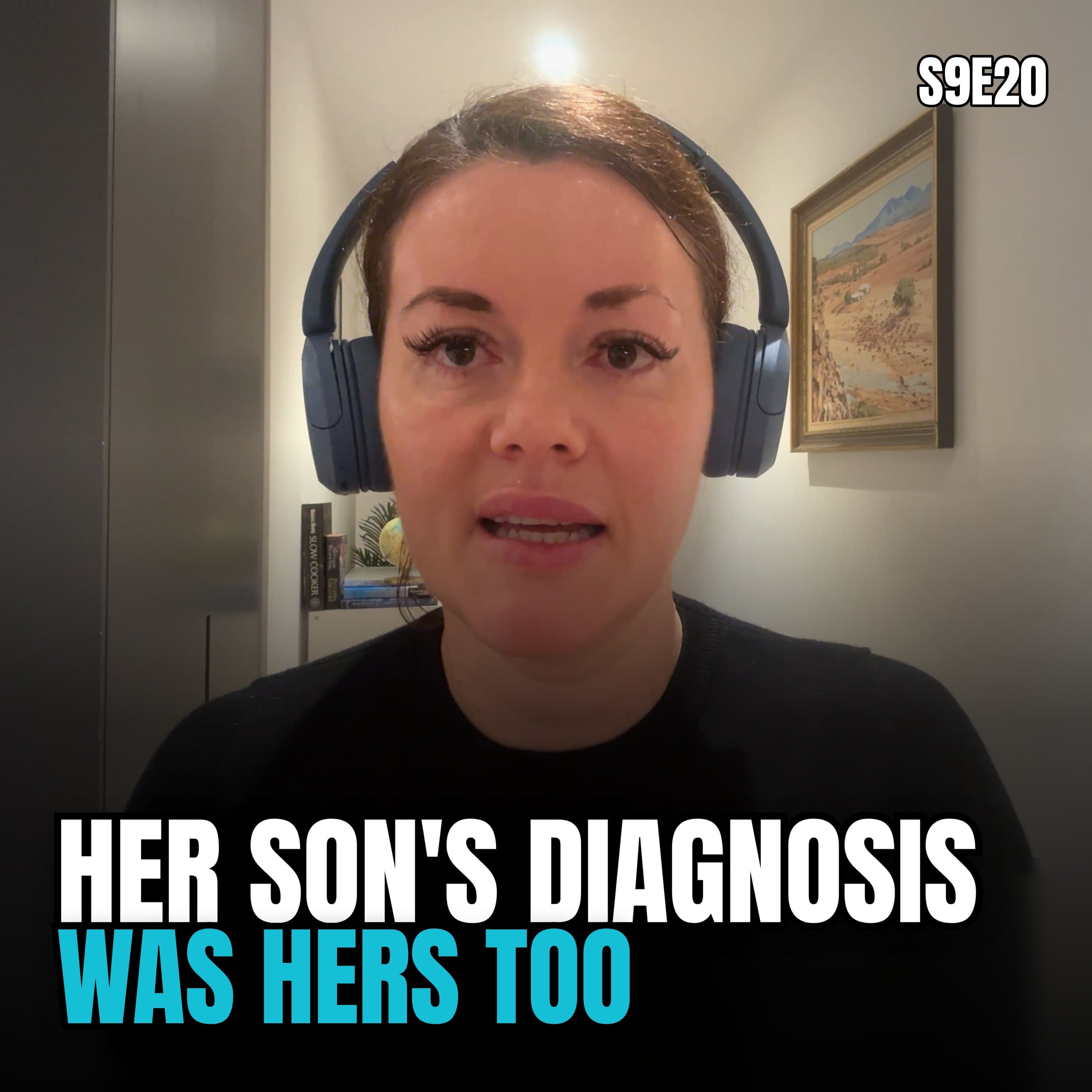
Stephanie Kerns was a teacher before she was an autism mom, and the only autism she'd seen up close was in boys. So when her daughter started putting sponges in her mouth and echoing every question back in the exact tone it was asked, the first read was a speech delay.
"I was an educator before I was an autism parent. I didn't know a lot about autism until we started this journey with my daughter. I did teach boys on the spectrum, so I only saw boys on the spectrum. That was kind of my window into autism."
Her own daughter didn't look like any of those boys.
"She presented so differently. I just thought she had a speech delay, honestly."
Her daughter is 14, about to be 15, verbal, and diagnosed Level 1. That's the level everyone hears as easy. Stephanie lives in Colorado with her husband of almost 18 years, both of them educators, and a son who's 12. This is a Seen and Heard conversation, so it's short, and it's about what a week looks like inside a house that looks like any other house from the sidewalk.
This episode is presented by Mightier. Details at the bottom of the post.
Sponges, echolalia, and an hour every morning
The early signs were there. Stephanie just didn't have the frame for them yet.
"She liked to put sponges in her mouth. I just thought, you know, that's something that toddlers do. I didn't know she was sensory seeking."
Then the echolalia. She'd ask her daughter about her day at dinner and get the question handed right back.
"At the end of the day I would ask her at dinner, 'Hey, how was your day?' And she'd be like, 'Hey, how was your day?' In the exact same tone I would ask it. So she was not expressing her own thoughts."
And the meltdowns. Nobody hands a first-time parent a chart of what a normal tantrum looks like.
"I didn't know toddler tantrums usually are three to five minutes, not an hour long. So we were dealing with those hour-long tantrums almost every morning before school. And then I'd be frazzled going to work after trying to get that meltdown to calm down."
Then she walked into a classroom and taught other people's kids all day.
An IEP at three, a level years later
The school district identified autism for an IEP when her daughter was close to three. The medical diagnosis came later, and only because Stephanie pushed for it. Preschool, kindergarten, first grade, more concerns, and she went to the doctor and asked for a referral herself. Several sessions with a neurologist later, she had the diagnosis and a level she'd only just heard existed.
"So I asked the neurologist, and she told me your daughter's at a level one, which is considered high functioning, low support. And so I was like, okay. So I started more research about level one, because my daughter is verbal."
Here's the line that became the title of this episode, and she said it first.
"At the time, verbal didn't mean easy. It still does not, especially as a teenager. I feel like we're kind of like the toddler, but with more communication skills and hormones."
Three weeks of spirit week
A typical day starts at five. Same routine every morning, because her daughter is rigid and routine is what holds the morning together. Breakfast, videos in the office they share, hair, teeth. Then the school ran spirit week for three weeks straight.
"We've had three weeks of spirit week. I don't wish that on any family."
One morning it was a camouflage shirt that couldn't be found, then a camo shirt that didn't match the camo pants, because the pants were in the wash. Stephanie compromised her way out the door, and that night they sat down and planned the next day's outfit so the next morning wouldn't blow up too.
"So it was just about planning and being open about changes. But yeah, spirit week was definitely stressful the last few weeks."
This one hit home for me. My boys went to a charter school with uniforms, and I loved it. Blue shirt or blue shirt, khakis, done. Then spirit week would show up and demand a lion shirt or whatever it was that year, and with everything else going on in our lives, that shirt was the last thing on my radar. Our kids take that information in and it becomes an event they have to live up to, to the letter. Everything has to work or none of it does.
So I'll say it the way I said it on the tape. Level one does not mean easy.
The win: a stutter at 13, and phasing out of speech
Ask Stephanie about a recent win and she goes to speech therapy, and specifically to getting out of it.
"Probably this last year we did phase out of speech therapy. So that was great. She had made great gains with speech."
The road there was strange. A little over a year before this conversation, her daughter developed a stutter out of nowhere, at 13. Whole words, not the start of them. I, I. What, what, what. Stephanie has speech therapists in her professional circle, and every one of them said the same thing: get her into private speech on top of what the school provides. So they doubled up.
"It made a huge difference. So the stuttering has ceased. But again, with autism, it ebbs and flows. So you just take things as they go, and we phase in and phase out things."
Her best guess at what happened, from the speech providers she talked to, is a late language explosion colliding with puberty. Nobody knows for sure. That's autism. You phase in, you phase out, and you take the win when it lands.
Hang out with her for a day
So who's the kid people hear "Level 1" and file under easy?
She's creative. She comes home from school and needs to cool down, because she's been masking all day. She writes stories. She's focused on her handwriting right now. She wrote a song and her dad wrote the guitar part, and the two of them were rehearsing it for the school talent show. She memorizes like it's nothing, which is why she keeps landing roles in the school drama program. She does accents. Her mom can't.
And then there's the sentence every Level 1 parent has heard.
"But to most people who just meet her, when I tell them that she has autism, it's like, she doesn't look autistic, or she doesn't present. I'm like, hang out with her for a day. You'll see some things. You'll see some little quirks. You just never know."
Her teachers learn it the same way, every year.
"As her new teachers have gotten to know her, they're like, yeah, I didn't see it. But then after having a week or two of class with her, it's, okay, there it is."
I used to tell people the same thing about Gavin, my oldest. He regressed hard around four, and went from ahead in speech and language to something that looked the same on the outside and wasn't the same at all. Meet him for a minute and you'd think, cute kid, what's the problem? Give him five minutes. Not because he was a bad kid. He wasn't. It's the repetition. The same question, over and over and over, until you'd confess to anything to make it stop. And Emmett, my youngest, didn't speak until he was four. A non-speaker and a kid who wouldn't stop talking, in the same house, and both of them wore you down in their own way.
A secret society
The Seen and Heard questions are the reason this series exists. What do you wish the outside world understood, and does the world actually see and hear your family? Stephanie's answer is about everything that doesn't show.
"Just understanding those hidden challenges. I feel like we're kind of in a secret society, honestly, because they just don't understand what a week looks like. They don't understand therapy. They don't understand we're rushing off to meet community, find people that understand us, and just looking for friends."
Her daughter wants friends. She has a few, and she always wants more, and it doesn't come to her the way it comes to neurotypical kids. So they go to teen meetups where she can meet people like her, and the families phase in and out of each other's lives the way busy families do.
"I understand parenting is hard for everybody, but autism parenting, it's on a different level. I think a lot of the things that we do are just not seen."
Does the outside world see and hear her family? She doesn't think so.
"They see my family walking around and we look like a normal family. But we have those hidden challenges."
And this is where she lands, and where a lot of us land. They keep it in, they do their thing, and they advocate for their daughter.
"Our whole goal is for her to be independent and happy, and my husband and I are both on the same page about that."
Find your people
Turned inward, toward the autism community itself, her message is about the parents who never find their people.
"I feel like a lot of people just don't find community, and when you find your people, that's huge."
Level 1, Level 2, Level 3, she says, we're all dealing with different things, and we can still come together, problem solve, share resources, and tell another mom, I'm here for you. Early on she was talking to people who weren't autism parents, and they had no idea what she was carrying into work every morning.
"They had no idea those mornings I was dealing with hour-long meltdowns and coming to school frazzled. Here I am with my smile on my face to do my thing."
Then the part I want every newly diagnosed parent to hear.
"You get that diagnosis, it's a lot. There's grief involved. But you really need to reach out, find your people, find your support group, and share and be open about it, because otherwise I just feel like you're in a dark place."
Both sides of the IEP table
Does she feel seen and heard by the autism community? Her answer is careful, and it's about the job she does all day.
"I'm also an educator too, so some people may think that is a threat. But I'm also a parent too, so I've seen both sides of the IEP table. I want to advocate for everybody involved, as a parent and as an educator. And I would like to be more involved. I feel like I'm just getting started."
My partner, Kelly, was an educator for twenty years, and her daughter is autistic. All that classroom and admin experience softened the landing when the diagnosis came, and it was still a completely different thing when it was her own kid. I was a medic for a long time. I could handle anybody else's emergency. My own boys' emergencies were something else. Stephanie lives in that gap every day, and she's choosing to use it.
Thirty pairs of shoes
I closed with something I say a lot, because I think it's the whole point of this series. When Emmett wore the same shoes to school two days in a row, most people would've shrugged. My kid wears shoes everywhere, so what? Do you have any idea? Those were thirty pairs of shoes I bought because they felt good, and then the next day he wouldn't wear them again. Two days in a row was huge, and it took years. The achievements our kids and our families rack up are things other people take for granted, the same way I take walking for granted.
So here's what I hope you take from Stephanie's story. Get curious. When another family's road looks different from yours, don't assume it's the same as yours, and don't assume they're doing it wrong. Ask. Listen. Hang out with them for a day.
About Stephanie Kerns
Stephanie Kerns lives in Colorado with her husband of almost 18 years and their two kids, a 14-year-old daughter diagnosed with Level 1 autism and a 12-year-old son. Both parents are educators. Stephanie taught boys on the spectrum before she had a child on it, and her work today keeps her in autism support on the school side, which puts her on both sides of the IEP table. Her daughter was identified for an IEP at three and got a medical diagnosis, and her level, from a neurologist a few years later. She phased out of speech therapy this past year, writes songs and stories, performs in the school drama program, and does accents her mom can't.
This episode is presented by Mightier
Mightier is a biofeedback video game program developed and tested at Boston Children's Hospital. Your kid wears a heart rate monitor and plays games that get harder when they get dysregulated and easier when they calm down. So instead of being told to take a deep breath in the middle of a meltdown, they practice regulation in their own body, at a moment when they can actually feel it working.
It's one of the very few things I've stood behind for years, because it helped my boys connect the dots when nothing else did.
Visit mightier.com and use code theautismdad22 for 10% off.
This episode is sponsored. I only work with companies I'd point a friend toward.
My book
So Your Child Was Just Diagnosed with Autism: Real Talk, Support, and Next Steps from a Dad Who's Been There is out December 29, 2026 from Fair Winds Press. If your child was just diagnosed, this is your compassionate first step guide from someone who's lived it. Preorder here.