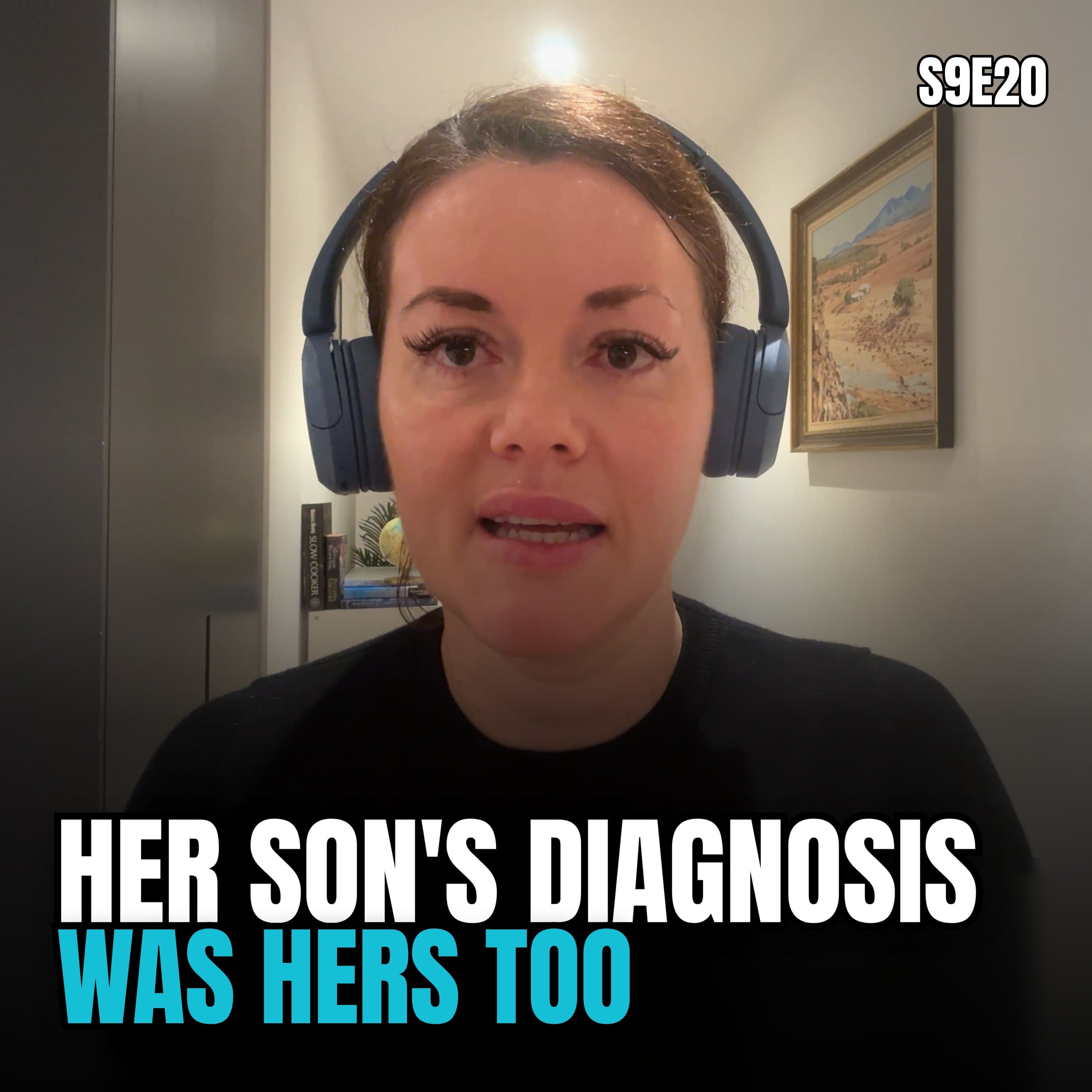
A stranger at a park watched Nicole Carbone's son hum to himself and asked her a question she is still carrying around.
"I had somebody say to me, like, does he ever shut that motor off? And I kind of was like, well, no. That's his thing, and he's autistic."
Her son Luca is almost four, nonspeaking, and diagnosed with Level 2 autism. Nicole lives in western Pennsylvania with her husband and their twins, about forty five minutes from me. After Luca's diagnosis she went looking for help, found out how much of what families need is not covered by insurance, and started a nonprofit to buy it for them.
This episode is sponsored by PESI. Details at the bottom of the post.
The head banging is the communication
Ask her what the hardest part of a normal day is and she does not say behavior. She says communication, and then explains that the two are the same thing.
"The main thing is communication barriers with him. He is more self-destructive, so if he cannot communicate his needs, he does a lot of head banging on whatever object. Doesn't matter what it is."
Whatever is closest. A wall, a floor, a table. And then she says the part that most people outside this do not know what to do with.
"I've learned that his pain tolerance is very high."
"He'll stop before he hurts himself" is not true
I had to stop her here, because I have heard the same sentence for twenty five years about my oldest.
"I would have people tell me like, oh, don't worry about it, he's not going to hit his head hard enough, he'll stop before he hurts himself. And it's like, no. No, he won't. He will do that until he passes out."
Nicole has heard it too, and she has stopped being polite about it.
"I tell people all the time. No, he doesn't feel pain."
Gavin's pain receptors were flipped. He would slam a finger in a car door and barely react, then fall apart over a paper cut. He would eat until he was sick because the signal telling him he was full never arrived. So often I would hear that he will stop eating when he is hungry. No, he will not.
Nicole thinks a lot of it is sensory, and she has watched it closely enough to separate two different things that look identical from across a room.
"He also bangs his head just because it's like a sensory thing. He does it when he's not angry, but he really does it when he's angry."
Splitting the twins, and the device that might change everything
The family is working toward an AAC device, an augmentative and alternative communication tool, in the hope that giving Luca a way to say what he needs will take away the reason to hurt himself.
Getting him there cost something. Nicole moved him to a different preschool from his twin sister, so he could get three days a week of speech and occupational therapy.
"I kind of separated my kids, which is super hard for me, because they're twins and they've been together since they were born."
She is honest about who that was hard on. Luca went and did the thing he liked and did not look back. It was hard on her.
The best video she will ever have
I ask everybody in this series about a recent win, big or small, because we celebrate all of them. Nicole had one, and it was not small.
"He's been mimicking, which is huge. Huge, huge, huge."
They were in the bedroom, looking at each other, and she could tell he was tuned in.
"I was like, oh, say hi mommy. And he said hi mommy. Not perfect, but he said it. I've never heard him say that in the almost four years that he's been in this world."
She got it on camera.
"It's like the best video that I will ever, ever have."
Who Luca is, once you stop listing his support needs
Ask her to describe him and she does not lead with the diagnosis.
He is relentless. If he sees something he wants, redirecting him is not a strategy that exists in their house. He can climb anything and get down from it fine, which is great for him and less great for a parent with anxiety. And Nicole has already worked out what to do with that.
"I like his persistence, because you can kind of turn that into a positive at some point once it becomes safe for him."
Don't compare your kid
The last question in this series is about what she wishes other people in the autism community understood. She did not need a run up.
"Don't compare your kid to any other kid that has Level 2."
Level 2 is the middle of the spectrum and it is enormously wide. Level 1 gets read as easy, which it is not. Level 3 means substantial daily support. Level 2 sits between them and holds children whose days have almost nothing in common, and Nicole watches families line those children up against each other anyway.
"Trying to compare is the biggest challenge with Level 2 autism, and it's even the same way for any of the levels."
This is my biggest pet peeve in our community. If my kid is doing something that your kid cannot, that does not mean you are doing something wrong or I am doing something better. It means they are two different humans. We create tensions and lines in the sand because we will not let everybody's experience coexist.
Does she feel seen and heard
"I am now."
Not always. What changed is that she started advocating publicly, got involved with local agencies, and built something. Now she talks to families she never would have met, about the really good days and the really hard ones both.
"There's no reason to be embarrassed. Your kid is just as great as they were the day they were born. They just need a little bit of extra support."
The NEST Project
Nicole is the founder and president of The NEST Project, a 501(c)(3) serving families across Pennsylvania and Ohio. It buys the things insurance will not cover for children with disabilities. Sensory tools, adaptive clothing, safety equipment, crisis support.
"If you have a special needs kid, you know how expensive they can be, and how many things are not covered by insurance."
You can find them at nestcares.org.
This episode is sponsored by PESI
PESI's 2026 Kids and Teens Autism Symposium runs November 18 and 19, online, and it is neuro-affirming the whole way through. There is a full session on demand avoidance, for every kid who got called defiant when it was really their nervous system. There is another on kids who mask so well they get treated for anxiety instead of what is actually going on.
Two hundred dollars for both days, up to 18 CE hours, and a 30 day replay if you cannot be there live. It is built for clinicians, and parents can register too.
Listen to the episode
Seen and Heard is a short series from The Autism Dad Podcast. Real families get about fifteen minutes to describe their actual lives, in their own words, without anyone smoothing it out for them.
If your child has just been diagnosed and you are reeling, my book comes out December 29, 2026. It is called So Your Child Was Just Diagnosed with Autism: Real Talk, Support, and Next Steps from a Dad Who's Been There, and you can preorder it here.